
Samuel Rocca (illustrated by Christa Hook), “The Army of Herod the Great” (Osprey: Oxford, 2009).

Pages: 44
RRP: £12.99
In this book Samuel Rocca explores the army of Herod the Great, its composition, equipment, and military campaigns. The Herodian kingdom’s position on the frontier of the expanding Roman Empire meant that the state’s military forces would play an important role in numerous events of significance for Roman history both during and after the reign of Herod the Great (37-4BC). Like other books in Osprey’s Men at Arms series this is a short work, but one packed full of information, pictures and useful references, making effective use of the latest literature on archaeological discoveries and historiographical discussions.
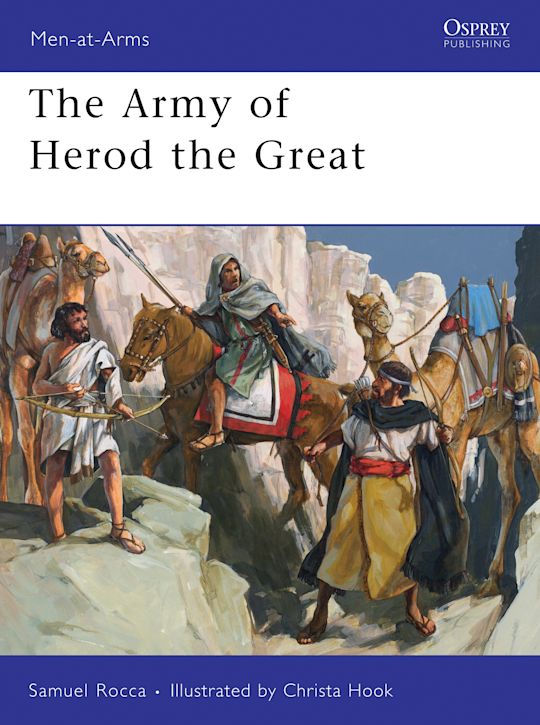
The book begins with a high-level summary of who Herod the Great was and the role of his army. It then progresses into a discussion of the ethnic composition of his troops, the various branches of the force (infantry, cavalry, engineers and so on) and then an overview of the composition of the field army and the equipment it used. Rocca proceeds to look at the campaigns Herod’s army fought in during his reign, which includes Herod’s conquest of the kingdom, the First Nabatean War, Aelius Gallus’ expedition, and the Second Nabatean War. This section is concluded with a brief examination of the army after Herod’s death in 4BC and a short (but useful) bibliography. Finally, commentary is provided on the various superb colour plates that illustrate the book, the discussion of which is supported by references to surviving artefacts. I found the colour plates and commentary section to be the most valuable element of the book as although there are several histories of Herod the Great, including one by Rocca, little has been written about how the army of the Herodian dynasty would have looked outside of scholarly articles published in academic journals.
As a side note, I would consider this book to be essential reading for students of the First Jewish War interested in the equipment used by the rebel forces. Although the Jewish armies used captured Roman equipment, they are also known to have raided numerous state armouries at the start of the conflict. Consequently, it is highly probable that their forces exhibited a blend of equipment from both sources (as well as local acquisitions and those sourced from friendly neighbouring states) throughout the war.
Although short, this book fills an important gap in the literature of ancient warfare. I consider this is a must-have reference book for anyone interested in either the Herodian military or the history of Jewish revolts during the 1st centuries BC/AD.

Comments