
Wargaming the Jewish Revolts: The Bar Kokhba War – Rome’s Vietnam?

Unlike the First Jewish War, far less is known about the Second Jewish War, or the Bar Kokhba War. This is because no primary source similar to Josephus’ “Jewish War” survives for this conflict. What we do know comes from fairly fragmentary sources at some remove from events. As an example of how little we really know, the true name of the rebel leader was not rediscovered until a cache of letters was found in the refugee caves of Nahal Hever in 1961. His actual name appears to have been Shim’on Ben Koseba, ‘Bar Kokhba’ apparently being either an error made by the Romans or by later scribes. Virtually nothing is known about the course of the war itself. Even the details of the climax of the campaign, the fall of Betar in 135AD (the location of which is not known for certain), are not known other than the fact that it lasted “a long time” and ended in a slaughter of the inhabitants.
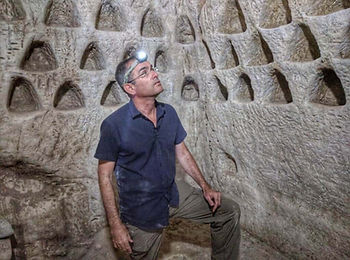
However, while we may never know the details of this war, we can make some educated guesses about how it may have been fought on (and under) the ground. One of the defining characteristics of the war was the rebel's use of underground hideouts, both as a way to protect non-combatants and as an offensive weapon. The presence of dozens of underground hideouts throughout the rebel held area of Judaea, many of which were constructed in the years immediately prior to the outbreak of the revolt, suggest that the rebels intended to adopt a guerrilla war strategy. The use of such systems, often linked to the presence of settlements, seems to be one of the fundamental differences between the First Jewish War and the Bar Kokhba War. Although some underground systems were used in the First War (in addition to the caves around Masada, for example), there appear to be far more deliberately constructed hideouts in the period of the Bar Kokhba War, suggesting a different approach was being taken by the rebels.
While some of these hideouts appear to have been intended for whole communities to hide in, others appear to have been built as places of refuge for small bands of armed men, perhaps as lairs that they could use to launch surprise attacks on their opponents. Most of these hideouts feature cramped and narrow tunnels, passable only by one person at a time who would have to walk hunched over. That these underground hideouts seem to have been a linchpin of the rebel strategy is perhaps borne out by the discovery of caches of letters in some of these locations to and from rebel leaders (including Bar Kokhba). While set-piece sieges of rebel occupied towns may have occurred during the war, it does not seem likely that sieges like this were the norm (although we should of course remember that absence of evidence is not evidence of absence).
Thus, unlike the First Jewish War which principally revolved around numerous set-piece sieges of towns, the Bar Kokhba War seems likely to have involved a long struggle between the guerrillas and the Romans out in the countryside. It is not hard to imagine the Roman forces scouring the land for elusive bands of rebels, all the while being subject to hit-and-run attacks from small warbands. Given the brutality with which the Jews were treated following this conflict, I suspect that this four year war rapidly turned into something like Rome’s own Vietnam.
Wargaming the Bar Kokhba War must, I believe, take guerrilla warfare as its key theme. Most battles are going to be skirmishes rather than set piece engagements, which makes this perfect if you want to do some ancient wargaming without having to paint up entire armies. Rebel forces should be fast moving and lightly equipped. They should be encouraged to make use of terrain, their local knowledge allowing them to ambush their opponents. For some added flavour, rebel forces can also include mercenaries from neighbouring regions, such as Nabataea. Meanwhile, the Romans likely made extensive use of lighter auxiliary troops, backed up by heavy legionaries. Scenarios could involve rebels raiding Roman convoys, or perhaps see the rebels trying to fight off a Roman raid on a village. For the ambitious gamer there is the opportunity to create a bespoke board depicting the war underground, with Romans trying to fight their way into one of the underground rebel strongholds.

Comments